
Bluebird, Peninah, and Mary Utah
Mothering the Sacred

I was sitting at the table Rafka had wood-burned, but didn’t finish. My fingers traced the pattern she had started as I remembered how the varnish had smoked under the wood-burner and set us all coughing. I smiled.
Weeks earlier we had been meditating in the back room, the one that was used as a nursery by the home’s original owners. Rafka said that while meditating, an image came into her mind of the Shoshone people I was always going on about. One of them had given her an imaginal bluebird feather, she reported, quite innocently.
We were two very white, very Mormon girls. Gripped with concerns about boundaries and cultural appropriation I noted what she said, and tried to allow the delicacy of her experience to exist in my world without crudely popping it. I kept my concerns to myself.
We were sharing a meal. Wolfe, Rafka’s soon-to-be fiancé, was eating with us. Bubbling over with the usual pain and urgency, I was telling Wolfe about Pernetta. “There is a Native American woman in my family tree too,” he said. Quite casually, he mentioned his ancestress, Peninah Shropshire Cotton, describing her as he had been taught to—as the first Lamanite to be baptized, in this dispensation.
I bristled. Evidently it wasn’t just my family who compensated for their shame by emphasizing racist, historic “firsts.” The Murdocks claimed that Pernetta was the first Lamanite to go through the temple. I researched Peninah later that night online. I had to admit, she did look native. Whatever her tribal affiliation was, if she had one, it seemed to have been lost to time. Cherokee was the giveaway.
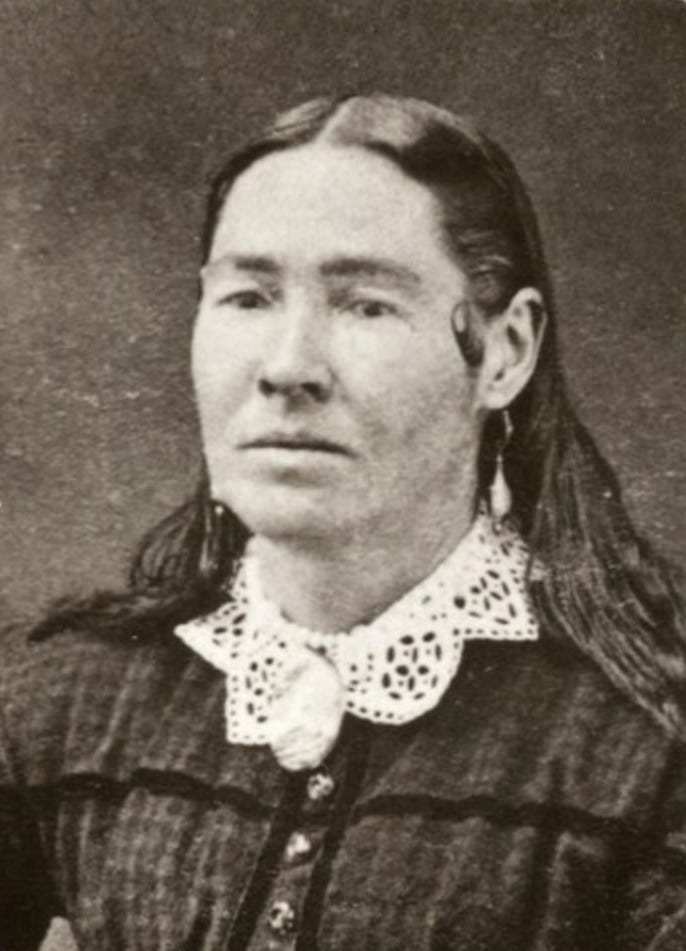
By that time I knew that claims to Cherokee ancestry were so prolific amongst Americans that some writers referred to this phenomenon as “the Cherokee myth.” More often than not these claims are based in family folklore, rather than verifiable genealogy. Anytime you see the phrase “Cherokee princess” employed by a fair-skinned person, you can be nearly certain this cultural-level fallacy is at play.1
According to Gregory Smithers, a professor of native history, in 2010, the Census Bureau reported that 819,105 Americans claimed at least one Cherokee ancestor.2 By contrast, in 2012 there were only 330,716 enrolled Cherokee citizens. At the time Smithers’ article was published, the Cherokee Nation reported that over 200 fraudulent groups existed who claimed Cherokee identity.
Perhaps this myth captured the American imagination because of the Cherokee’s success as a nation rebuilding themselves after the dispersement of their diaspora through the Trail of Tears, Smithers writes. Or maybe it was because of the distance they traveled and how many people heard about them during that time. It’s very sad that members of the dominant culture in North America know so little about the aboriginal peoples of the continent that they default to lumping many, diverse tribal groups into one.3
Almost every time I’ve ever spoken to a white passing person who claims indigenous ancestry, it’s been Cherokee. There was that girl in my high school communications class, the one who claimed her spray tan was evidence of her 1/3rd Cherokee heritage. (If you understand how human reproductive biology works, you’ll immediately comprehend how that fraction doesn’t hold up well, especially given that I was in high school years before the rise of DNA ancestry testing.)
I’ve even met a legitimate descendant of Timpanogos Pernetta’s, who somehow concluded that she was Cherokee. And then there was Peninah. Was she truly Cherokee, or like so many, had she too been mythologized? Was she even native?
One descendant suggests that the story may have originated with Peninah’s maternal grandmother, Nancy Fulkerson.4 Evidently, one Peter Fulkerson and his young family were captured by natives after they moved to the border between Virginia and North Carolina (which are not Cherokee lands) in about 1760. The Fulkersons were forcibly moved to Ohio, where Peter was killed. His young daughter, Nancy, who was raised with the tribe took a native husband, and refused to rejoin the white settler population.
Another descendant argues that the story may have actually began with Peninah’s paternal grandmother, Sarah “Bluebird” Crouch, who was likely Choanoake.5 Sarah was born in North Carolina in 1756. At that time the indigenous population of the area looked very different than it does today. Many tribes which are no longer federally recognized covered the lands then, including the Pamlico, the Nesiok, the Machapunga, and the Choanoake peoples.
Rafka and Wolfe got engaged a few months after that dinner. After they married they moved into their first apartment, and I stayed at the house with the partially wood-burned table. One day in June as I was walking to the front door I noticed a little blue feather with a white tip sticking straight up out of the grass.
That feather was Rafka’s. I could feel it. Distress about cultural appropriation grabbed at me again. I told myself that if I left the feather alone the wind would blow it away.
That bluebird feather stayed lodged exactly where it was for three excruciating days. On the third day I worked up the courage to bring it inside. The next day, on a warm summer afternoon, I presented it to Rafka, who was, surprisingly, just as resistant to the feather as I was.
The strongest evidence that Peninah was indeed indigenous came 10 years later. Time had brought us—Wolfe, Rafka, and I—back again to the welcome table with the smoking varnish. On this side of a decade I was much more knowledgeable, more seasoned, and just a little less urgent in my delivery as we discussed the Timpanogos.
When Wolfe’s repeated mention of Peninah sent me into the root system of his online family tree again I was ready to spot some important details I couldn’t see before. Peninah’s son, Joseph C. Wood, described his mother as very industrious, and said that she practiced many traditional native life-ways, which often punctuated their days together.
“She knew how to strike a steel on a flint, or rub two boards together to start a fire, as matches were unknown. She could cover a pine knot up in the hot ashes and coals and it would keep a fire for days. She made moccasins for shoes, homemade brooms to sweep the crude floors. She doctored the sick horses and cows and raised motherless colts many times… She was never known to quarrel, never having much to say, but [she was] a real mother lioness.”6
I imagine that her feline-like maternal qualities must have been close to the surface when she adopted those three little Timpanogos children, Mary, Thomas, and Lucy.
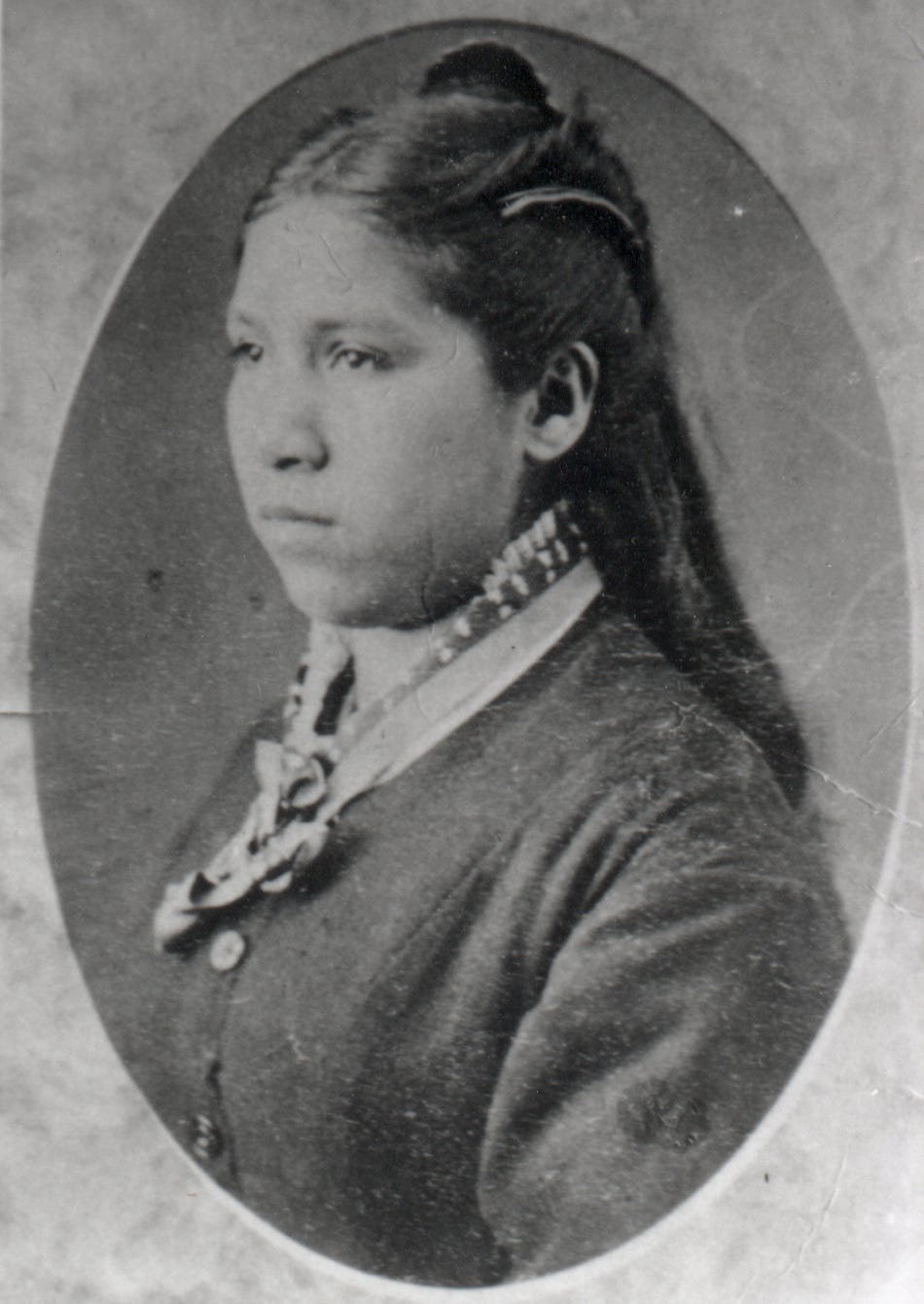
Peninah was Daniel Wood’s second wife. She originally came into the Wood family as a nursemaid for Mary, Daniel’s first wife. Mary was so impacted by the loss of their oldest son, Henry, that she became semi-invalid. A year after Henry’s death, in 1846, Daniel took Peninah as his second wife. Given that Peninah was a year younger than Daniel and Mary’s oldest daughter, it seems unlikely that she did much caretaking of his teenaged children.
Daniel, Peninah, Mary, and their children crossed from Nauvoo to Utah the summer of 1848. By that time, Peninah had a baby of her own, and she was pregnant with her second. They stayed in Millcreek for a year. In October of 1849 they relocated further north to the Bountiful area, where they eventually settled. Daniel Wood is the namesake of Woods Cross, Utah.
A curious family story tells of the three native children that Peninah adopted before they relocated north. Wood family history remembers that three children were found in the Southwest part of the Salt Lake Valley near the Jordan River a year or two after the Mormons arrived, and that they were the survivors of a massacre carried out by the "Black Hawk Indians."7
There was no such tribe, and history does not recount any such massacre. What history does remember, however, is the Battle Creek Massacre, which was perpetrated against the Timpanogos by the Mormons in March of 1849 near what is now known as Pleasant Grove, Utah. Antonga Black Hawk, who grew up to lead the Timpanogos in their defense against the Mormons, survived that massacre as a child.
While it may be true that Timpanogos men would sometimes kidnap children from other tribes and traffic them into the Spanish slave trade, they would not have raided their own people. Goshute lands were out by Tooele. Paiute lands were much further south. These three children were found along the banks of the Jordan River.
In the dialect spoken by these natives at that time, the word Timpanogos referred to the water systems in Utah. The Provo River, the Jordan River, and Utah Lake were all connected back then. Ergo, the banks of the Jordan River would have been Timpanogos territory.
Long ago, the Choanoake peoples who lived on the lands we now call North Carolina were considered part of the Iroquois Federation. A lovely story about bluebirds is nestled in Iroqouis myth. It is said that the bluebird chases away the ice, snow, and frost of winter.
In some versions of the tale, this force of winter is personified. A mother has two sons. One twin, Tawiscaron, kills his mother, and the bluebird defeats him. How does something so small vanquish something so destructive and all encompassing? Simply. With her song.
Peninah’s son, John, may not be the most trustworthy reporter of his mother’s life or priorities. While he described her as a woman who was proud of her native heritage on the one hand, he also emphasized that she was “a true, Christian colonizer, a real colonizer” in the stories he told about her. I’ve read hundreds of pioneer life sketches in my day—this is language I haven’t seen before.
The description seems forced to me, compensatory. When John goes on to say that Peninah struggled to learn the alphabet, but ultimately mastered it so that she could read her favorite book, The Book of Mormon, the ruse is revealed. If Peninah truly were indigenous, living in Utah during that window of time, she would have been the subject of racist treatment by many of her neighbors.
The bedrock of the colonizing enterprise was the eradication of native culture. Any bit of native culture that Peninah retained would have been cause for suspicion. It seems plausible that her son, John, after years of poor treatment, felt the need to put it down in ink that his mother was truly converted. Let the record show that Peninah really was invested in the cultural aims of the colonizing project of Mormonism.
But was she truly? John did characterize his mother as someone who never had very much to say. What would she have said, had anyone been listening? What would she say now?
During the era in which Peninah adopted the three Timpanogos children, Utah (oftentimes spelled Eutah) was an exonym for the Timpanogos. The Eutah peoples included the Timpanogos, the Goshutes, and the Paiutes.
The people we now know as the Utes lived primarily in Colorado at that time. Somehow, they got conflated with these Utah peoples. This confusion may have happened in the 1890's when some of their people were forcibly marched from Colorado into Utah by the US Government.
Utah isn’t a word in their language. They called themselves the Nuche people. The Eutah peoples were a branch of the Shoshone tribe. The Nuche peoples (or Utes as we call them now) were more closely related to the Kiowa peoples and the Arapahoe. That’s true linguistically, anyways.
With this information in hand, we don’t have to wonder anymore why Peninah gave each of these children she adopted the middle name Utah. Of all of the circumstantial evidence that points to Peninah having been an indigenous woman, this might be the strongest.
We don’t see the word Lamanite appear in their names. We don’t see monikers from The Book of Mormon. No, we see a tribal designation. Thomas Utah Wood, Lucy Utah Wood, Mary Utah Wood.
While her husband’s religious community was trying to erase the Battle Creek Massacre and the Timpanogos peoples it targeted, Bluebird’s granddaughter was singing the snow and ice away. Peninah Shropshire Cotton was weaving the truth of who these babies were right into their so-called Christian names, and likely even deeper than that. That’s some mothering.
Sadly, our collective understanding of Peninah’s gift would erode over the generations, and fall into entropy. It would take nearly 200 years for it to surface again. Mary Utah Wood still has living descendants. So does Peninah. Three of them were hatched in a little nest built by my friends, Rafka and Wolfe.
From what I’ve seen over the last decade working with this story, many of these descendants are still wandering, looking for some kind of closure on behalf of their ancestresses. Many of them are still searching for home. There’s a lot we’ll never know about both of these women, Peninah in particular.
Was she Choanoake? What did she really think about The Book of Mormon? Was she happy in the Wood family? How did she commune with her ancestors? Did she have a native name? What did her mother call her?8
The week I decided I was going to write about Peninah, Rafka texted me. She’d been out for a walk in the forest, and she’d found another bluebird feather. When I reminded her of the feathers of yesteryear the pieces dropped into place. I would try to transcribe Peninah’s song as I heard it, after all, then.
We may never find the answers to these questions written down in a book, or stored away in some archive. We might never be able to prove anything, about Peninah’s history or Mary Utah’s history, but that doesn’t mean we can’t feel it.
Home is right here. It’s in our connection to these ancestors, and to all of the rest of them too, even those who dealt the hurt, who dealt the wounding. Home is as easy to find as it is to register a bluebird’s chirp. All we have to do is listen.
Reflection Question 1
When untampered with, tribal belonging is generally based on relationship in indigenous culture. Blood quantum—the idea that you have to be a certain percentage Native American in order to be included in a tribe—is an idea imposed on tribes by colonial outsiders. It’s a way for colonizers to diminish a tribe’s size or power, by controlling who is in and who is out.
Despite all of this, oftentimes orphans who are generations removed from living tribes will try to plug themselves back in—as in the case of the Cherokee. This puts a strain on living indigenous peoples. There may be no one living in a tribe anymore who remembers your ancestor. What’s done is done.
If this describes you—you are someone who was raised, culturally, as a white person, and your ancestor who was indigenous lost contact with their tribe generations ago… what is here for you? Where does your drive to reconnect with living people from this tradition come from? If a living tribe cannot help you address that, where could you find resources that could?
Reflection Question 2
If you are someone of mixed heritage, it might be worthwhile to ask yourself, “Why do I feel a stronger connection to my indigenous ancestor(s), then I do to my European ancestors?” It could take years to unravel the answer to that question.
For some people, that pull could be a call towards something—healing work, environmental activism, something that they might one day offer their community. If that’s the case, it will be the sort of thing that unfolds slowly. It will need your loving touch for many years.
It may also be true that it is easier for you to identify with the victimized indigenous than it is to identify with their oppressors. Perhaps there is some ancestral grief or trauma that wants to be released through you. The end goal of healing is integration—we embody all that we are, accept all of the stories that have come together to give us life. That too is a long journey.
If you have both Mormon and indigenous heritage, and you feel pulled to connect with your indigenous ancestors, I would invite you to ask yourself: “What do I still need to understand about the shadows of Mormon colonization? What will that cost me? If I am willing to pay that cost, what kind of love do I need to be giving myself so that I can see what needs to be seen?”
Reflection Question 3
When members of a dominant culture subsume ideas, artifacts, and practices from an oppressed culture we call that cultural appropriation. Oftentimes this is most easily visible in the marketplace, where you might find (for example) native mascots, Indian costumes, and dream catchers being peddled by white people.
Cultural appropriation can also happen in more subtle, spiritual ways. Depending on the context, activities like saging, administering cacao, divining spirit animals, and even drumming can be done in very disrespectful, exploitative ways. If you are a fair-skinned person who facilitates these practices for others, it would be best if you have a living relationship with an indigenous teacher, and you have been given permission to offer these traditions to others.9
Where does that leave those of us who are of mixed ancestry, but who don’t have living connection with a native tribe? True spirituality isn’t easily controlled. Sometimes, things just happen. If something outside of the worldview you were raised in is happening for you spiritually, something that feels connected to your indigenous ancestors, here are some questions you could ask yourself:
What if I didn’t have to convert anyone to this way of being? What if this message was just for me? If this message were coming to me in the spirit of simple love, without expectations or strings attached, what would that mean to me?
Thank you for reading. If this essay was meaningful to you, please consider supporting the Timpanogos tribe with a donation through their website. Utah residents, descendants of Mormon pioneers, or other interested parties can also sign a petition asking Governor Spencer Cox to rescind Brigham Young’s 1850 extermination orders against the Timpanogos.
In this presentation Gene Norris talks about how royalty is a European concept superimposed on indigenous culture. He reports that in 2011 alone 24,000 people from the dominant culture contacted the Cherokee Heritage Center looking for information on their purported Cherokee ancestors.
Norris, Gene. “My Great-Grandma was a Cherokee Princess and Other Misconceptions.” Cherokee Nation History Talk Series. Talequah, Cherokee Nation. 24 February 2012. Accessed on YouTube 9 April 2025.
Smithers, Gregory D. “Why Do So Many Americans Think They Have Cherokee Blood? The History of a Myth.” 27 October 2015. https://time.com/4089303/cherokee-ancestry/. Accessed online 9 April 2025.
If you’d like to learn more about which specific tribal groups lay ancestral claim to the land you live on, here’s a great resource: https://native-land.ca/
Grant, Vaughn. “Cherokee Nation Will Return.” Blogpost. Moderate But Passionate. 5 November 2013. http://www.moderatebutpassionate.com/2013/11/cherokee-nation-will-return.html. Accessed online 9 April 2015.
This idea comes from Alyssa Calder Hulme, who recommends the following article, which touches on the conflation of the Cherokee and the Choanoke:
Milteer, Warren E. “From Indians to Colored People: The Problem of Racial Categories and the Persistence of the Chowans in North Carolina.” The North Carolina Historical Review. Vol. 93, No. 1 (Jan 2016), pp. 28-57.
“Peninah Shropshire Cotton Wood: Life Story.” Found in Richard Moyle Collection. https://www.familysearch.org/memories/memory/188831529?cid=mem_copy. Accessed online 9 April 2025.
Salter, Naomia Mae. “Daniel and Peninah Wood’s 3 Little Indian Children.” Affidavit. https://www.familysearch.org/memories/memory/134550417?cid=mem_copy. Accessed online 10 April 2025.
Peninah is not an indigenous name. It’s biblical, actually. Old Testament Peninah was the sister-wife of Hannah, the woman of grief. The name derives from the Hebrew word peninim, which is usually translated into “rubies,” but sometimes, “pearls.”
Drumming has roots in almost all human culture. If you are a fair-skinned person who drums, consider asking yourself this question. What would happen if you used drumming to foster an authentic connection to the cultures of your indigenous European ancestors, rather than the cultures of Native American peoples?