
Emma Grace Austin
Reflections on Mormon Ancestry

“Were my ancestors involved in the genocide of the Timpanogos nation?” I’m surprised I don’t hear this question asked more often. Whether or not it is verbalized in settings where this history gets discussed it always seems to be in the room. It has a way of silently hanging over conversations about the Timpanogos, arbitrating what people hear and do not hear.
For those who retain strong connections to the institution and doctrines of the Church of Jesus Christ of Latter-day Saints, an affirmative answer to that question challenges most beliefs they’ve been taught to hold dear. Learning about this genocide and its subsequent erasure can be challenging enough to a faith structure, but learning that your family was involved? That presents an entirely different challenge—one that can easily strain or combust present day attachments and relationships.
Post-Mormons can also be hesitant to ask the question. Why is that? One answer may be that pop social justice ideology runs on shame, and it can be just as intensely moralistic and condemning as Mormon orthodoxy. If you don’t conform to the new moral order, you’re again at risk for being exiled from the group.
You have ancestors who perpetrated this genocide? Watch out. If your new social system is entangled in an ideology like the one I am describing this knowledge could translate as vulnerability, which certain malignant personalities might exploit. When you do face your shame, may you do it away from people who intend to keep you anchored to it endlessly.
No matter where you are positioned on the Mormon faith spectrum, an affirmative answer to that question has the capacity to destabilize you. So, caution around this question of personal ancestry makes sense, and it can be wise, to a point. If, however, this is part of your legacy, and you intend to integrate it, eventually you will need to confront it. So long as you are ignorant to your own history, any attempts at reparations are unlikely to fully bake.
There is beauty to be found in an affirmative answer, though. Or, at the least, coherence. Turns out there isn’t a soul on Earth who wasn’t born in blood. Turns out, if you travel far enough down into the roots of your family tree, you’ll see that your life (probably many times) came into being at the expense of someone else’s. We all have blood on our hands, and then again, we do not.
You are not responsible for what your ancestors perpetrated, although you did, through no choice of your own, reap the consequences. I use the word consequences instead of benefits purposefully here. Plenty has been said and will continue to be said about the privileges we’ve inherited. Our ancestors made a trade-off in this genocide which I’ve never seen accounted for.
Land and security may have been seized for a time and passed generationally, but soul was sacrificed in the bargain. If you don’t believe in soul, then there is no personal loss for Mormon descendants to grieve. But, if you do, well… Resources and land can be returned to indigenous peoples much more easily than soul can be recovered.
What I am alluding to may sound like an Old Testament generational curse engineered by a vengeful God, but that’s not what I mean by what I’ve written, not at all. Soulfulness, true spiritual life, the capacity to love and be loved, the ability to surrender before the mystery—these were sold out by our ancestors who chose genocide. What was left unresolved was passed down. God has very little to do with it.
I cannot adequately explain the relief that comes with squaring off to reality, but I can attest to it. There is deep pain and grief that follows the decision to accept reality on its terms, but there is also a freedom, a quietude, which I recommend. The reality here is if you have Mormon ancestors, chances are extremely good that you have at least one ancestor who participated in this genocide.
In the case that you do not, I thought I’d introduce you to another one of my ancestors, Emma Grace Austin.
Emma and her husband, John, met Mormon missionaries in Bedfordshire, England well after Mormon pioneers entered the Salt Lake Valley. After the Austins were baptized, they traveled across the Atlantic Ocean on a ship called the Minnesota. Railroad tracks had been laid by that time, so they did not travel to Utah by handcart or by wagon—they came in by train.
The year was 1868, one year after Chief Tabby led the surviving Timpanogos to their reservation in Heber, Utah. It just so happened that Emma and John built a small log cabin in what is now Lehi, Utah. Eventually, they built a hotel.
Emma’s numerous sons became involved in the sugar beet industry, managing the fields, and later the beet factory that dumped refuse into the lake. After their mother died in 1893, her sons pooled their money together and purchased Sulphur Springs, land around the lake that became known as Saratoga Springs in later years. In the first half of the twentieth century, Austin descendants would gather to cruise on the Pagadi’t (Utah Lake) for their family reunions.
That land stayed in my family for a generation or more. The Austin’s first log cabin stayed in the family much longer. Within the last decade it was donated to the Hutchings Museum in Lehi, Utah, where it stands outside as part of a permanent exhibition.
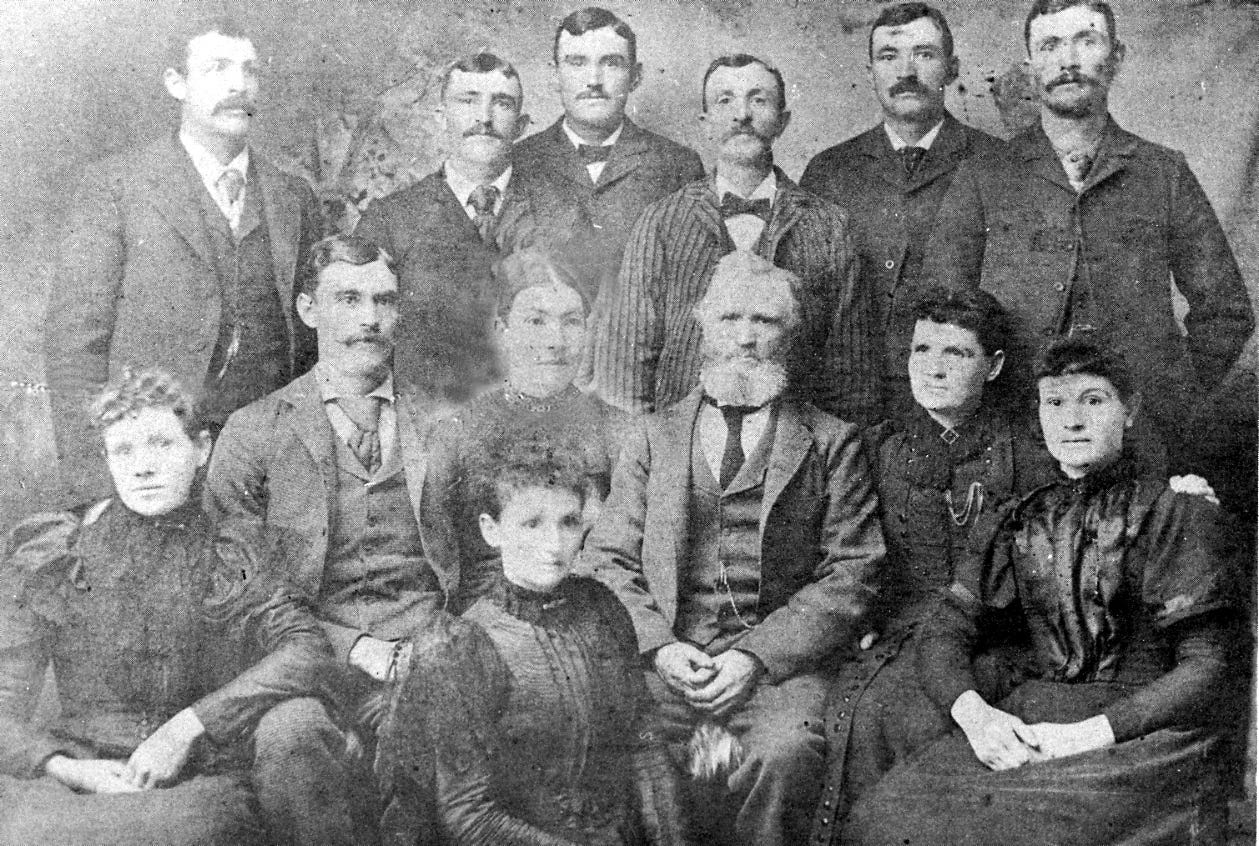
The Austins are one example of a Mormon pioneer era family who had nothing to do with the Timpanogos genocide. None of their sons enlisted. No honored veterans of the “Indian War” here.1 By the time the Austins arrived at Utah Lake, the Timpanogos had already been relocated.
There are many such stories in Mormon history. Although we often think of our Mormon ancestral narratives in monolithic terms, as I’ve written before there actually was significant diversity amongst these people—regarding their ancestral cultures, their interpretations of the gospel, their adherence to Brigham Young’s dogma, etcetera. They were a rare anomaly, but there were even families who treated the Timpanogos with kindness and dignity. How those families got mixed up in Mormonism is anyone’s guess, but somehow they did, and we are all better for it.
I have seen several Mormon family trees that are without any direct ties to the Timpanogos genocide. Although, remember, every new generation acquires twice as many ancestors as their parents. Most of the family trees I have looked at belong to Millennial aged Mormons. As each new generation arrives it becomes less and less likely that these children will not have ties to genocidal actors.
It should also be said that families who settled in Northern Utah may have sustained the Bear River Massacre against the Hookuu Dikka (Northwestern Shoshone). Families further south may have been connected to the Circleville Massacre against the Pai-uttahs (Paiutes). There are a variety of threads a committed researcher could pull on here. Expect what you yank out to be tragic, and you’ll be right 95% of the time.
So, what do we do with this? I’d like to offer a few ideas for you to chew on while you’re deciding whether or not you will look at your family tree.
The first is this: different actors bear differing levels of responsibility. Young men who were enlisted in these militias are less responsible than military leaders. Lay people were often abused and manipulated by religious leaders—which is something to take into consideration. Some pioneers may have been bamboozled, and led to Utah under false pretenses, unaware of what they’d be asked to do once they arrived.2
When I write about this history I point to Brigham Young as being the ultimate culprit, because he is most responsible for what happened. This is true because Brigham was conscious about what he was doing, and he had the most political power. He may have never entered the fray, but he was moving the pieces on the chessboard. The thousands of Timpanogos lives that were lost all trace back to his leadership, and the sustaining influence of the immediate circle of brothers surrounding him—the First Presidency and the Quorum of the 12 Apostles of that era.
Ultimately, it’s going to fall on your shoulders to make distinctions about your ancestors. Try to sit with the pain. If you catch yourself reaching for easy solutions, pull back that outstretched hand, if you can. Here are some questions you could meditate on while considering any ancestors you do find who perpetrated this violence:
Was this man a killer? Did he want to do this? Did he pull the trigger? Was he psychologically intact? What was his personal relationship to power?3
Surely there must have been a range of motivations amongst these soldiers. However, in our desire to hold out for the best case scenarios we can’t dismiss the obvious—Brigham Young’s regime empowered sociopaths, and those who would kill for sport. So, what happens if you descend from one of those folks?
Well, you’re in good company. Brigham Young has upwards of 30,000 descendants. His apostle and comrade, Parley P. Pratt, is estimated to have more than 60,000, notably including Mitt Romney. These staggering numbers are among the many reasons that we cannot ask the Timpanogos to be our healers. This is work that we must carry on our own.
And consider this—Brigham Young is so established in the gene pool in Utah that there are even members of the Timpanogos nation who descend from him. This tells us that we have got to start thinking very differently about ancestry, and what it means to us. As more and more of us descend from both perpetrators and victims, these old narratives of ever-lasting shame and familial culpability won’t hold water in the same way anymore.
Although not everyone will experience that tension in alignment with separate racial categories in their ancestry, legacies involving predators and victims exist in families of every color. The Austin family didn’t perpetrate the genocide against the Timpanogos, but they did develop their ancestral lands, and they did pollute their sacred waters.
What does it mean that my ancestors may not have perpetrated violence against the Timpanogos, but that they were okay, even eager, to settle their land? Some people came to Utah as adults. Some came as children. That’s something else to consider.
What does it mean to you if you cannot honestly be proud of your ancestors? You were taught that your identity was linked to theirs. Likely you were taught that you should derive pride, and a lot of it, from who these people were and the bravery they exhibited when they made all of those sacrifices to come to Utah. If that schematic is no longer operational, what does that mean to you?
If these are among the questions that stir in your mind as you stand before your family tree, I’d offer you this: do not forget that before long you will be the ancestor. So, your ancestors didn’t leave you a legacy that can honestly make you proud? Break the chain. Be an offshoot. Be the ancestor who will.
Reflection Question 1
If you’re reading this essay, that probably means you have been following along for awhile now. Something about this subject matter is of enough interest to you that you’re still reading. What is it? Why do you keep coming back to these essays? What moves inside of you when you read about this history?
Reflection Question 2
Have you dug into your family tree? What comes up for you when you think about the possibility of investigating your pedigree for personal connections to this genocide? If you can, write about any resistance that you may be feeling. What are you afraid that you might find? What are you worried the worst case scenario would mean to you?
Reflection Question 3
Are there pockets of your life, or your experience, that may open if you move in closer to your family tree? Are there intergenerational patterns that might need to be held in consciousness? Or maybe you can feel personal grief or unresolved trauma inching towards the surface. What feelings arise in you when you meditate on these possibilities?
Thank you for reading. If this essay was meaningful to you, please consider supporting the Timpanogos tribe with a donation through their website. Utah residents, descendants of Mormon pioneers, or other interested parties can also sign a petition asking Governor Spencer Cox to rescind Brigham Young’s 1850 extermination orders against the Timpanogos.
If you go looking in your family tree for evidence that your ancestors were involved in this genocide, any documentation (affidavits, memorials, medals) connecting an ancestor to an Indian War is a sure sign that they were.
Given the fact that the Church’s main proselytizing tool was The Book of Mormon, and that at that time it was believed to be a literal history of the indigenous peoples of America, I think it is foolish for us to claim that converts had no idea what they were getting into. Perhaps they believed that these native people could be converted, and they were unaware that genocide was on the table. No matter how you spin it, though, adult converts to the faith had to be on board with some of the basic tenets of colonization. It’s better for us to own that than excuse it away.